
By Hon. E. P. Chet Greene
August 30 2026 | Featured Story

Canada Prime Minister Mark Carney and President Donald Trump hold a press conference at the White House.
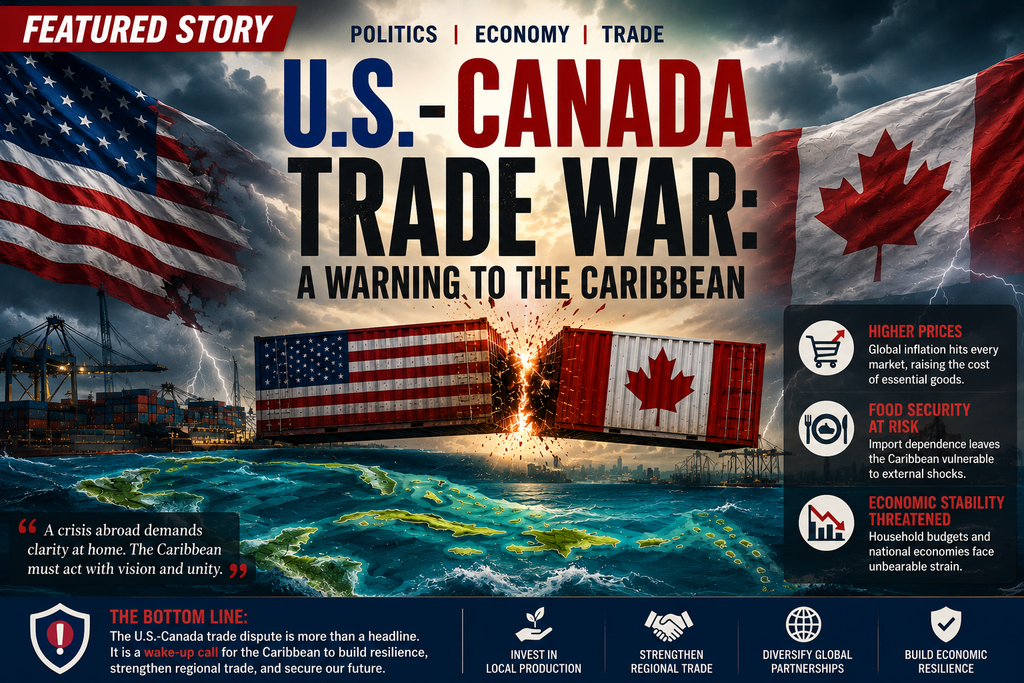
The recent disturbances in the trade relationship between the United States and Canada, marked by the imposition of significant tariffs and reciprocal measures, are a matter of profound concern for the entire hemispheric community. While these events may appear, at first glance, to be a bilateral disagreement between two northern neighbors, their repercussions and implications are neither remote nor contained. For the countries of the Caribbean this development represents a seismic shift in the very architecture of the global and regional order that has, for decades, provided a measure of predictability and stability upon which small states have depended.
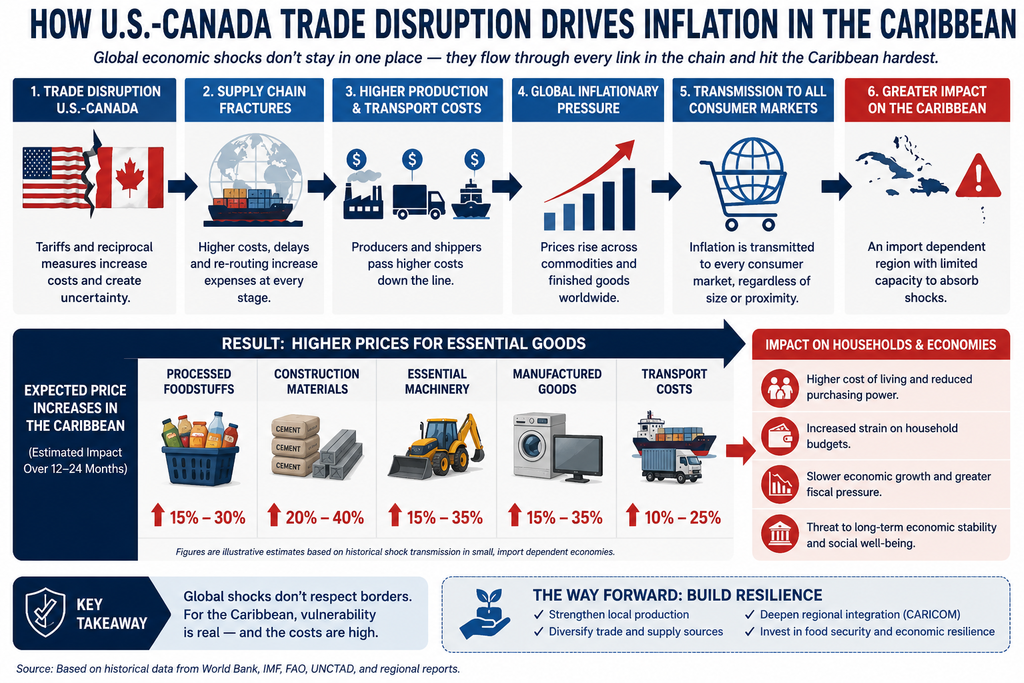
To understand the gravity of the situation, one must first appreciate the deeply interconnected nature of the economies of the Americas. The economic relationship between the United States and Canada is not merely a trading partnership; it is the world’s most integrated bilateral commercial artery, a veritable engine of production where goods, components and services crisscross the border with seamless regularity.
This intricate integration has been a cornerstone of prosperity for the hemisphere, generating efficiency and economies of scale that have, in turn, stabilized prices for a vast array of commodities and finished goods. The introduction of punitive tariffs into this finely calibrated system acts not as a precise corrective but as a blunt instrument that fractures supply chains and introduces cascading costs at every juncture. The inevitable result is a global inflationary pressure that will, without fail, be transmitted to every consumer market, regardless of its size or proximity to the point of origin. For the Caribbean, an import dependent region with limited capacity to absorb such shocks, this will translate into higher prices for everything from processed foodstuffs and construction materials to essential machinery and manufactured goods, placing an unbearable strain on household budgets and national economic stability.

The concern, however, transcends mere economics. This crisis if not urgently addressed, carries with it a more ominous geopolitical dimension.
The use of economic coercion as a primary instrument of statecraft, particularly between close allies, fundamentally undermines the rules based international order that was painstakingly constructed over the last eight decades. This order, with all of its imperfections, succeeded in creating a framework where disputes were resolved through negotiation and established norms, rather than through unilateral action and the threat of force.
The dismantling of this framework in favor of an aggressive, protectionist policy of “might makes right” introduces a dangerous volatility into international affairs. When trust between allies erodes and economic warfare becomes normalized, the margin for miscalculation narrows precipitously. While the immediate dispute is commercial, the logic of escalating confrontation risks drawing the Americas down a perilous path toward a more fractious and less secure future, where the specter of broader conflict moves from the realm of the unthinkable into the realm of the conceivable. This is a prospect that should give pause to all peace loving nations, especially those whose security and prosperity are inextricably linked to the maintenance of hemispheric stability.
For Antigua and Barbuda and by extension the wider Caribbean Community, these developments cast a stark light on a vulnerability that has long been acknowledged but never with such urgency: the imperative of food security and sovereignty. The region has historically relied on the steady, affordable flow of food imports from its large northern neighbors, a system that functioned effectively under the old global order. That system is now demonstrably fragile. The current dispute serves as a clarion call that the era of unquestioned reliance on external markets for our daily sustenance is no longer tenable. In this new and uncertain environment, the security of our food supply is synonymous with our national security.

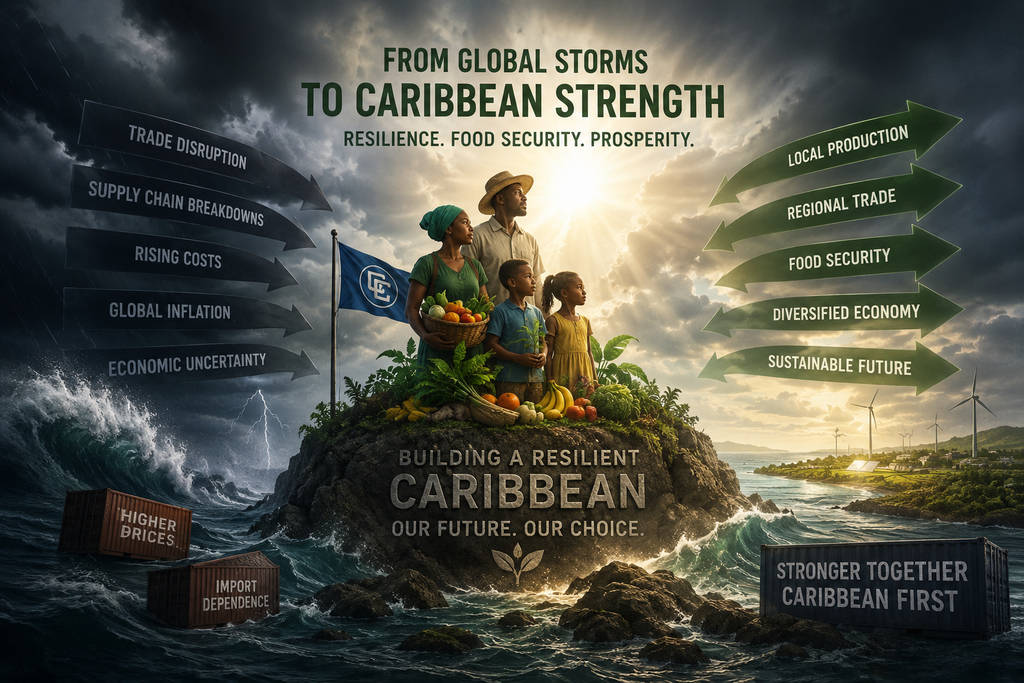
The imperative, therefore, is to accelerate and deepen our commitment to a “Caribbean First” agricultural policy. This involves a strategic redirection of investment toward sustainable, climate smart local agriculture; the active and urgent pursuit of a fully integrated regional food market within CARICOM to reduce duplication and leverage collective bargaining power and the diversification of our trade and cooperation partnerships to build resilience against the policy shocks of any single external power.
This U.S.-Canada trade dispute is more than a headline; it is a profound signal that the world is shifting toward a more protectionist and less cooperative paradigm. For the Caribbean, the path forward lies not in protest but in prudent, visionary action. We must heed this warning and fortify our own collective house, building the economic and agricultural resilience that will allow us to navigate these turbulent times. The responsibility falls upon us to ensure our own stability, for in the final analysis, the security of our people and the dignity of our nations must rest upon our own endeavors.