
By St. Pauls News Team
September 20 2026 | Intrenational
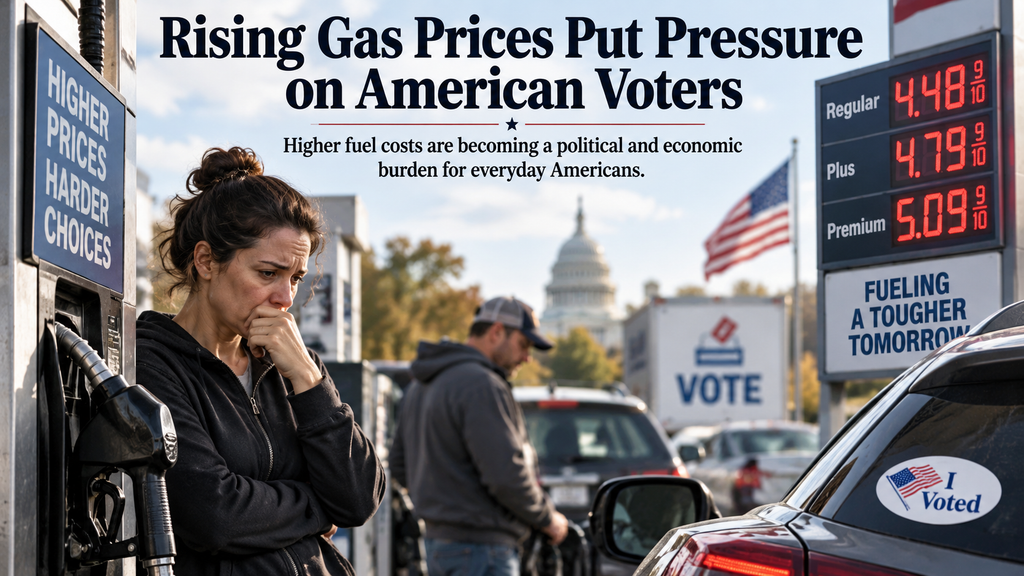
For millions of Americans, the rising price displayed at the gas pump has become more than an economic statistic. It is increasingly a question of how far their paycheque will stretch.
For Quinten Martinez, a 28-year-old Amazon delivery driver in South Texas, filling his vehicle has become a choice between competing household necessities.
“Is it going to be groceries this week?” Martinez asked as he watched the price climb at the pump. “Is it gonna be getting gas in our tank to go to work?”
His frustration reflects a broader concern emerging among American motorists as gasoline prices rise sharply and household budgets come under renewed pressure.
The issue has also become politically charged, with President Donald Trump defending higher fuel prices as a cost worth bearing because of the ongoing conflict with Iran.

Speaking during a campaign appearance in North Carolina, Trump acknowledged that gasoline had become more expensive but argued that the increase was a relatively small cost compared with what he described as the broader objectives of the war.
“You have a little higher. It’s a very inexpensive price to pay for what we’ve done,” Trump said, according to the report.
Martinez does not see it that way.
“I don’t feel like it’s a good trade-off,” he said. “I don’t feel like this is good for anyone.”
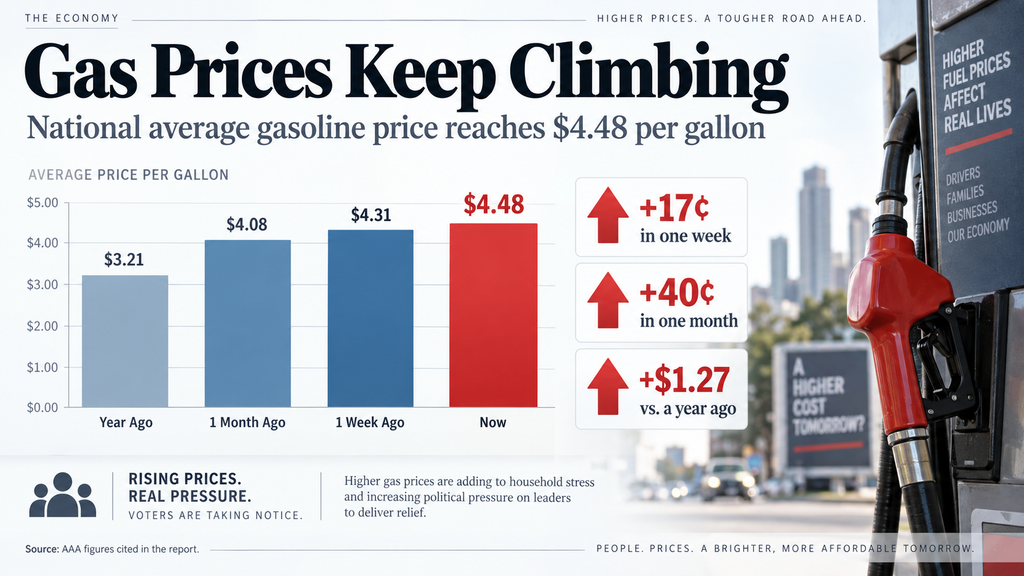
The national average price of gasoline reached $4.48 per gallon, according to AAA figures cited in the report. That represented an increase of approximately 17 cents over one week, 40 cents over a month and $1.27 compared with the same period a year earlier.
For motorists who depend on their vehicles to earn a living, the increases can quickly translate into higher weekly expenses.
Veteran Republican strategist Chris Wilson said gasoline prices have particular political significance because motorists encounter them repeatedly in their everyday lives.
“Gas prices matter because they’re one of the few economic indicators voters experience and see in real time,” Wilson said.

The price at the pump is also difficult for voters to ignore. Unlike some economic indicators that appear in monthly reports or financial statements, gasoline prices are visible every time drivers stop to refuel.
That makes the issue especially sensitive for working- and middle-class households whose budgets leave little room for unexpected increases.
The rising cost of fuel comes as American voters prepare for the November midterm elections.
The report describes a difficult political environment for Republicans, with concerns over affordability intersecting with Trump’s approval ratings and public debate over the Iran conflict.
Historically, the party occupying the White House has often suffered losses during midterm elections. However, individual races can be shaped by local candidates, issues and voter turnout, making the political consequences of economic concerns difficult to measure in isolation.
Interviews with voters cited in the report found frustration across party lines.
Some Democrats and independents said economic pressures could motivate them to vote against Republican candidates. At the same time, some Trump supporters remained committed to supporting Republicans despite expressing dissatisfaction with the state of the economy.
That divide illustrates the complexity of the political environment. Rising gasoline prices may be a significant concern, but voters are also weighing foreign policy, party loyalty, economic conditions and other issues when deciding how to vote.
For motorists such as Martinez, however, the political debate is ultimately connected to a very practical reality.
Every trip to the gas station brings another reminder of how much it costs to get to work, transport children, run errands or simply maintain a normal daily routine.