
By St. Paul’s News team
September 20 2026 | Regional
As Prostate Cancer Awareness Month is observed in September, health experts are urging Caribbean men to take a more proactive approach to their health, as the disease continues to place a significant burden on families and healthcare systems across the region.

Prostate cancer remains the most frequently diagnosed cancer among Caribbean men and is also a leading cause of cancer-related deaths.
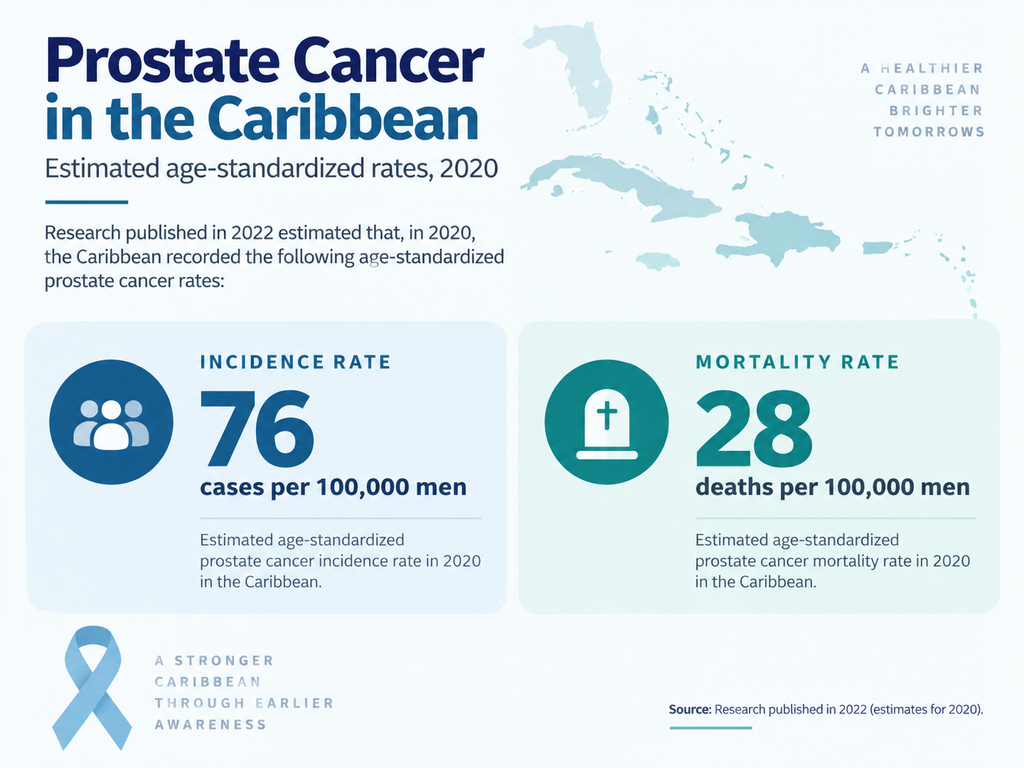
Research published in 2022 estimated that, in 2020, the Caribbean recorded an age-standardized prostate cancer incidence rate of approximately 76 cases per 100,000 men, while the mortality rate stood at about 28 deaths per 100,000 men.
These figures highlight the seriousness of the disease, although rates vary considerably from one Caribbean country or territory to another.
Importantly, the figures do not mean that 76 percent of Caribbean men develop prostate cancer or that 28 percent die from it. The incidence rate represents new cases within a population, while the mortality rate measures deaths within the population.
One of the greatest challenges surrounding prostate cancer is that it can develop without obvious symptoms, particularly in its early stages.
The prostate is a small gland located below the bladder and surrounding part of the urethra. It produces fluid that forms part of semen.
As men age, the prostate can become enlarged, a condition known as benign prostatic hyperplasia, or BPH. BPH is not cancer, but it can produce urinary symptoms that may also occur with prostate cancer.
When symptoms do occur, they can include difficulty starting urination, a weak or interrupted urine stream, frequent urination, especially during the night, and blood in the urine or semen.
Pain in the back, hips or pelvis can occur in more advanced disease.
However, these symptoms are not necessarily signs of cancer and can be associated with several other conditions. This is why medical assessment is important rather than attempting to determine the cause based on symptoms alone.
Age is among the strongest risk factors for prostate cancer, with the disease becoming more common as men get older.
Family history is another important consideration. A man whose father or brother has had prostate cancer may face a higher risk of developing the disease himself.
The issue also carries particular relevance for the Caribbean because men of African ancestry are recognized as having a higher risk of developing prostate cancer.
Other factors, including body weight, lifestyle and certain inherited genetic changes, may also influence an individual’s risk. However, having a risk factor does not mean that a man will necessarily develop prostate cancer.
Prostate cancer develops when cells in the prostate begin growing abnormally and uncontrollably. Some forms of the disease grow slowly, while others can be aggressive and spread beyond the prostate to nearby tissues, lymph nodes or distant organs, including the bones.
The stage at which the cancer is discovered can therefore be extremely important.
Men diagnosed with localized prostate cancer may have a strong chance of successful treatment, while advanced disease can be considerably more difficult to manage.

Screening and early assessment commonly involve discussions with a healthcare professional about a prostate-specific antigen (PSA) blood test and, where appropriate, a digital rectal examination (DRE).
A PSA test measures the level of prostate-specific antigen in the blood. A DRE allows a healthcare professional to physically assess the prostate for abnormalities.
Neither test, on its own, provides a definitive diagnosis of prostate cancer. Further evaluation may be required when results raise concerns.
A prostate cancer diagnosis does not automatically mean the same treatment or outcome for every man.
Treatment decisions depend on several factors, including the cancer’s stage and grade, how aggressively it is behaving and the patient’s overall health.
Depending on the circumstances, treatment may include active surveillance, surgery, radiation therapy or hormone treatment.
For some men with slow-growing, localized cancer, active surveillance may be recommended rather than immediate treatment. Others may require more intensive intervention.
The differences in disease progression and treatment options underline the importance of an individualized medical assessment.
The impact of prostate cancer extends well beyond the patient.
Families can face significant emotional and financial pressures when a loved one requires long-term treatment or care. Healthcare systems must also provide diagnostic services, specialist consultations, treatment and ongoing monitoring.
For Caribbean countries already dealing with the growing burden of noncommunicable diseases, prostate cancer adds another layer of pressure to limited healthcare resources.
Improving public awareness, encouraging appropriate conversations about screening and strengthening access to diagnostic and treatment services could help more men seek medical attention earlier.
Prostate Cancer Awareness Month provides an opportunity to move the conversation beyond statistics and encourage men to take an active role in their health.
Men should know their family history, understand their individual risk factors and speak with a healthcare professional about whether and when prostate cancer screening is appropriate for them.
They should also follow up on abnormal test results and seek medical advice if they experience persistent changes in urination, blood in the urine or semen, or other concerning symptoms.
For many men, the disease may initially offer few or no warning signs.
That makes awareness particularly important.
Know the risks. Get informed. Talk to your healthcare provider. And do not wait until symptoms become severe before seeking medical advice.