
By St. Paul’s News Team
September 27 2026 | Regional
PLAY VIDEO
From the Caribbean to the halls of the United Nations, Antigua and Barbuda delivered a message that goes to the heart of the concerns of small states: the strength of a country should not determine the weight of its voice.
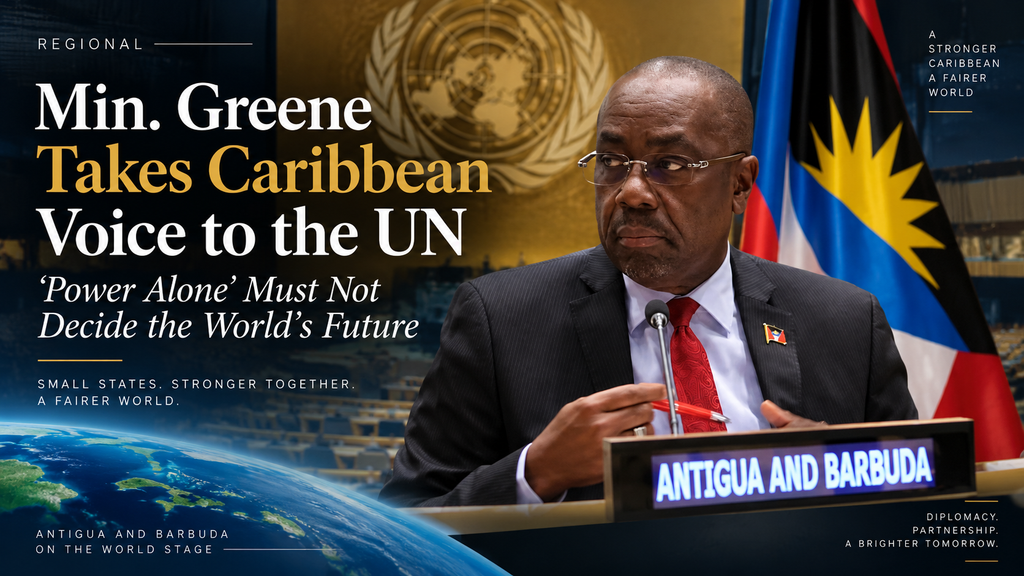
Foreign Affairs Minister E.P. Chet Greene, addressing a high-level meeting on international law during the 81st United Nations General Assembly, mounted a forceful defence of multilateralism and the principle that all nations—large or small—must have a meaningful place in the international system.
“For Antigua and Barbuda, there is simply too much at stake to accept a world where power alone determines outcomes,” Greene declared.
His message carries particular significance for the Caribbean, a region made up largely of small and developing states whose security, economies and future are closely tied to international cooperation and rules-based institutions.
Min. Greene argued that at a time when confidence in multilateral institutions is being tested, countries should not turn away from them.
“Our response must not be to walk away from multilateralism. It must be to repair it, strengthen it, make it work better,” he said.
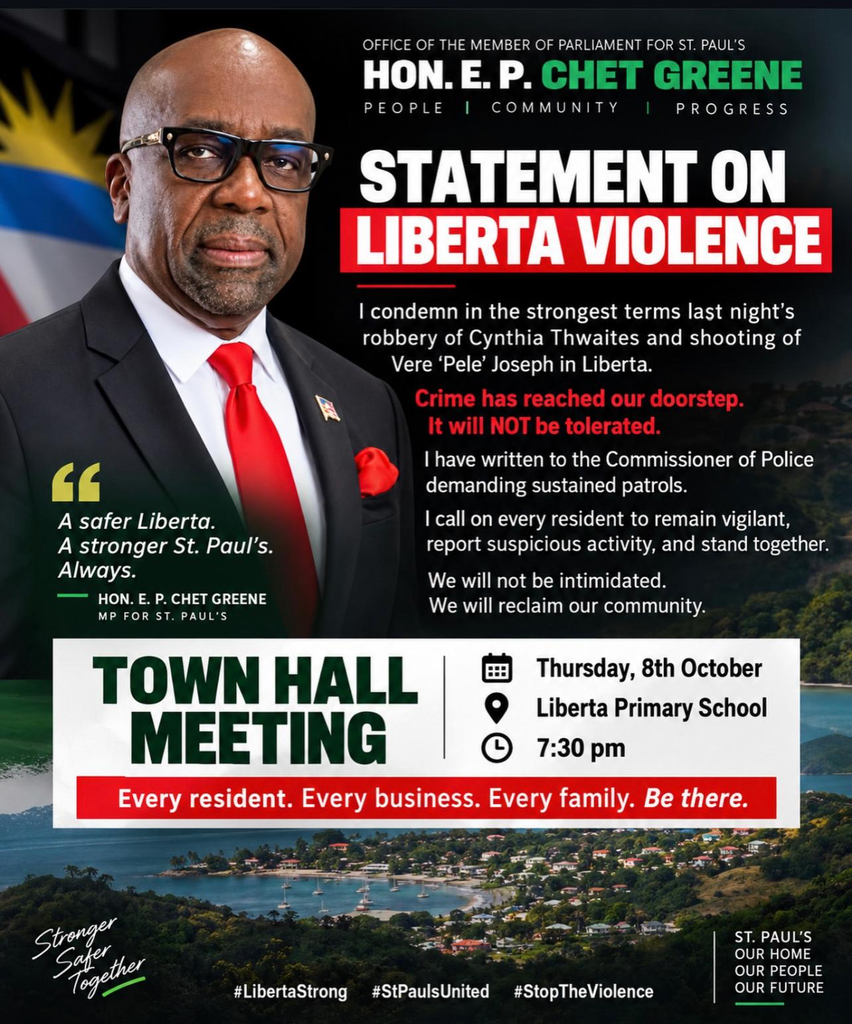
For Caribbean countries, the stakes extend well beyond diplomatic principle. Issues such as climate change, rising sea levels, economic vulnerability, development financing and international security cannot be addressed by small states acting alone.
Min. Greene stressed that international institutions must be strengthened, while those responsible for upholding international law must be supported and held accountable.
He also pointed to Antigua and Barbuda’s upcoming hosting of the Commonwealth Heads of Government Meeting and its nomination of María Fernanda Espinosa for UN Secretary-General as evidence of the country’s determination to remain engaged in shaping the international system.
“These are not separate initiatives,” Greene said. Rather, he described them as part of a wider effort to create a multilateral system that is more accountable, representative and effective. The minister’s intervention also placed the Caribbean’s long-standing advocacy for equality among nations firmly on the international stage.
For a region accustomed to navigating the decisions of far larger powers, Greene’s message was direct: Caribbean nations may be small in size, but they are not without influence—and their voices must count.
That message was underscored at the close of the meeting when a Palestinian delegate approached Greene and embraced him warmly in a visible gesture of appreciation.
In New York, Antigua and Barbuda was not simply speaking for itself. It was reinforcing a broader Caribbean argument—that a fair international order must give small states a meaningful voice in the decisions that shape their future.