
By Kamalie Mannix
August 23 2026 | Local
For many years, Antigua and Barbuda’s approach to waste management has been simple: collect it and take it to Cooks Landfill. But as our population grows, our economy expands, new communities are developed, tourist arrivals increase and our disposable incomes rise, one thing is certain: we will produce more waste.
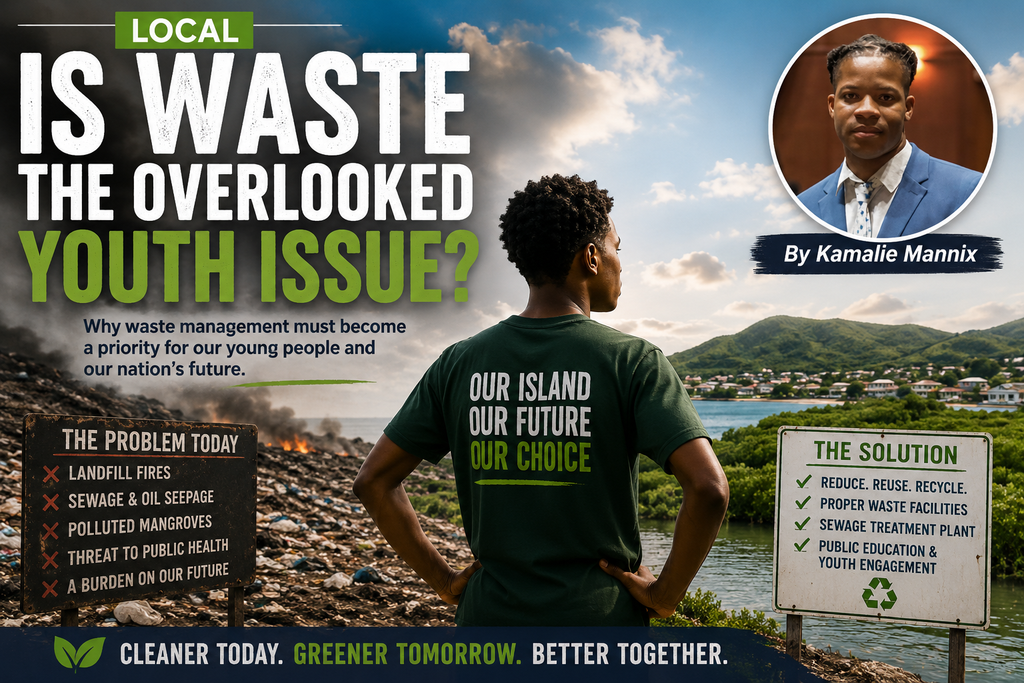
Cooks Landfill was once a saltwater marsh, with mangroves along its edges. Today, it has become a towering mound of waste, visible from surrounding communities. Material waste, old tyres and even raw human sewage have all found their way into the landfill. Fires at the site have become a recurring problem, with smoke inundating Five Islands and surrounding communities.
This is particularly concerning as Five Islands continues to develop, including the expansion of the University of the West Indies Five Islands Campus. We should never reach a point where classes have to be cancelled because smoke from a landfill fire has made the campus unsafe.
The environmental consequences are equally troubling. Recent sewage and oil seepage from the landfill into the mangroves behind the site had a devastating impact on the environment and Five Islands Harbour. These incidents remind us that waste management is not simply about keeping our streets clean. It is about public health, environmental protection, economic development and the future we leave for young people.
And what happens if Cooks Landfill eventually reaches its limit? Where will we put our waste? This is why waste management must become a youth issue.
The solution cannot simply be finding another place to dump our garbage. We need a modern system.
Antigua and Barbuda needs a proper sewage treatment plant, facilities that allow waste to be sorted, recycled and treated according to international standards, and a sustained public education campaign that teaches households and businesses better waste-management practices. Good Humans 268 deserves recognition for its effort to intervene and educate.

We must also recognize that this is not an Antigua and Barbuda problem alone. Across the region, governments are confronting the growing challenge of waste. Anguilla recently experienced a major landfill fire, while St. Kitts and Nevis also faces challenges associated with a landfill located in a sensitive coastal environment.
Good waste management will not be cheap. The State may have to develop mechanisms to ensure that the true cost of managing waste is covered. But the cost of doing nothing may ultimately be far greater.
Young people must therefore begin asking difficult questions. What happens to the waste we produce? Who pays for its disposal? Where will it go when our existing facilities are full?
And what kind of environment are we leaving behind?
We cannot demand economic growth and increased consumption without confronting the waste that comes with it.
Waste may not always be the most visible youth issue, but it is one that will increasingly shape our future. Proper waste management can protect our communities, preserve our environment and allow places like Five Islands to grow without constantly bearing the burden of Cooks Landfill.
The future is ours. So is the waste. We need to start managing both responsibly.