What If We Stopped Seeing Waste as Waste?
Good Humans 268 Inc
September 20 2026 | Local
For the last three years, we have been committed to changing the way people see waste. Not simply how we dispose of it, but how we value it, manage it and understand the opportunities hidden inside the things we throw away every single day. We have been pushing a simple idea: waste does not automatically become worthless because we are finished using it. In Antigua and Barbuda, we have estimated that waste has the potential to generate approximately EC$53 million annually. If that level of value exists in the materials we discard, then perhaps one of the most important questions we should be asking is this: why are we still treating so many valuable resources as garbage?
Part of changing people’s relationship with waste is allowing them to see what is possible. Over the last three years, we have experimented with ways of combining environmental education, creativity and community participation.
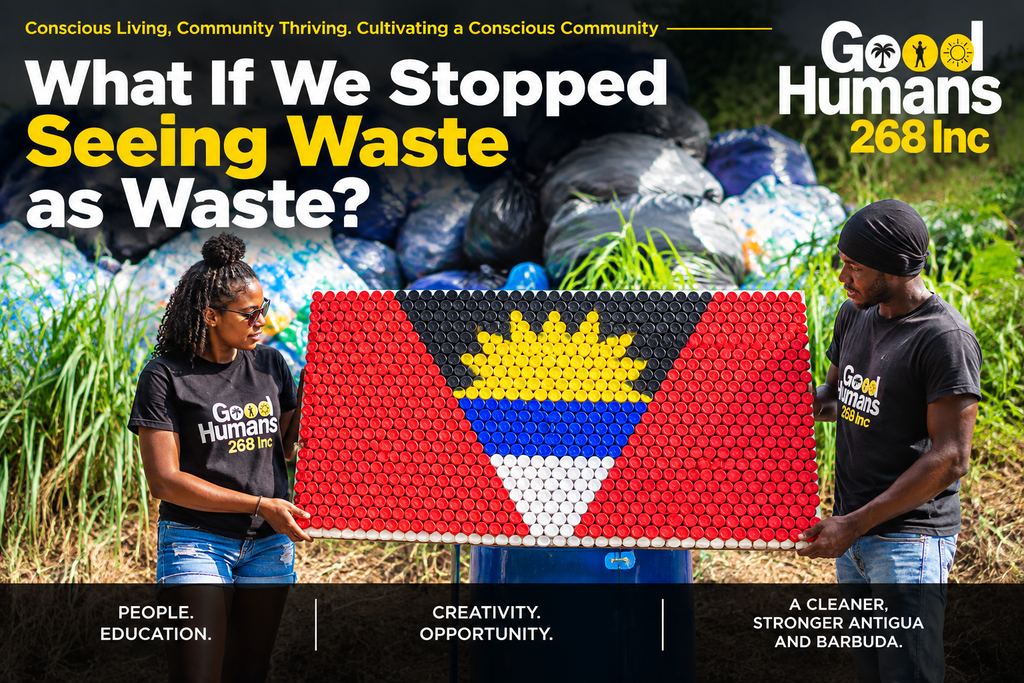
We have participated in Art Week, transformed discarded materials into art, created a giant teddy bear and undertaken several projects designed to make people stop, look and think. For Global Recycling Day, one of our biggest undertakings was the creation of a mega Antigua and Barbuda flag using approximately 27,000 plastic bottle caps. To help people visualize the size of that project, the finished flag covered approximately six sheets of plywood. Twenty-seven thousand tiny pieces of plastic that could easily have been thrown away were instead brought together to create something that represented our national identity.
Now we want to take that idea much further. With Antigua and Barbuda preparing to host the Commonwealth Heads of Government Meeting, we want to use this moment to demonstrate what can happen when environmental action, education, volunteerism and inclusion come together. Our next mission is to create the flags of the Commonwealth using discarded bottle caps.
The Antigua and Barbuda flag has already been completed, which means our goal is to create the remaining 55 flags. We estimate that we will need approximately 98,000 bottle caps and about 35 sheets of plywood to complete the project, with each country’s flag occupying roughly half of a sheet. It is ambitious, but the scale is exactly what makes the project an opportunity to start a much bigger conversation.
Before a single new flag can be completed, however, an enormous amount of work has to happen. We currently have thousands of plastic bottles stored at John Hughes, and the caps have to be removed from those bottles. The bottles can then be prepared and sent to the Antigua and Barbuda Waste Recycling Corporation for processing, while the caps will remain with us for the flag project. Those caps then have to be sorted according to colour so that we know exactly what we have available when we begin designing and constructing each country’s flag. This is where we need the public to become part of the mission.
We are planning several volunteer days at John Hughes where individuals, schools, businesses, service clubs, youth organisations, churches, community groups and families can come and help us remove and sort bottle caps. It may sound like a small task, but when you are trying to prepare approximately 98,000 caps, every pair of hands matters. Imagine what could happen if 100 people each helped us prepare 100 caps. Imagine 500 people participating. What if thousands of people across Antigua and Barbuda could eventually say that their hands contributed to creating the Commonwealth flags? That is the kind of community ownership we want this project to inspire.
Plastic waste is not simply an Antigua and Barbuda problem. According to the United Nations Environment Programme, humanity produces more than 400 million tonnes of plastic every year, with a significant amount designed for short-term or single use. Globally, only a relatively small proportion of plastic waste has historically been recycled. Plastic also does not simply disappear when we throw it away. Over time, larger plastic items can break into smaller pieces, including microplastics, and pollution can travel through drains, waterways and eventually into marine environments. For small island developing states surrounded by the ocean, the way we manage plastic waste is therefore not an abstract global environmental conversation. It is directly connected to our communities, our coastlines, our tourism product, our ecosystems and the country we leave behind for future generations.
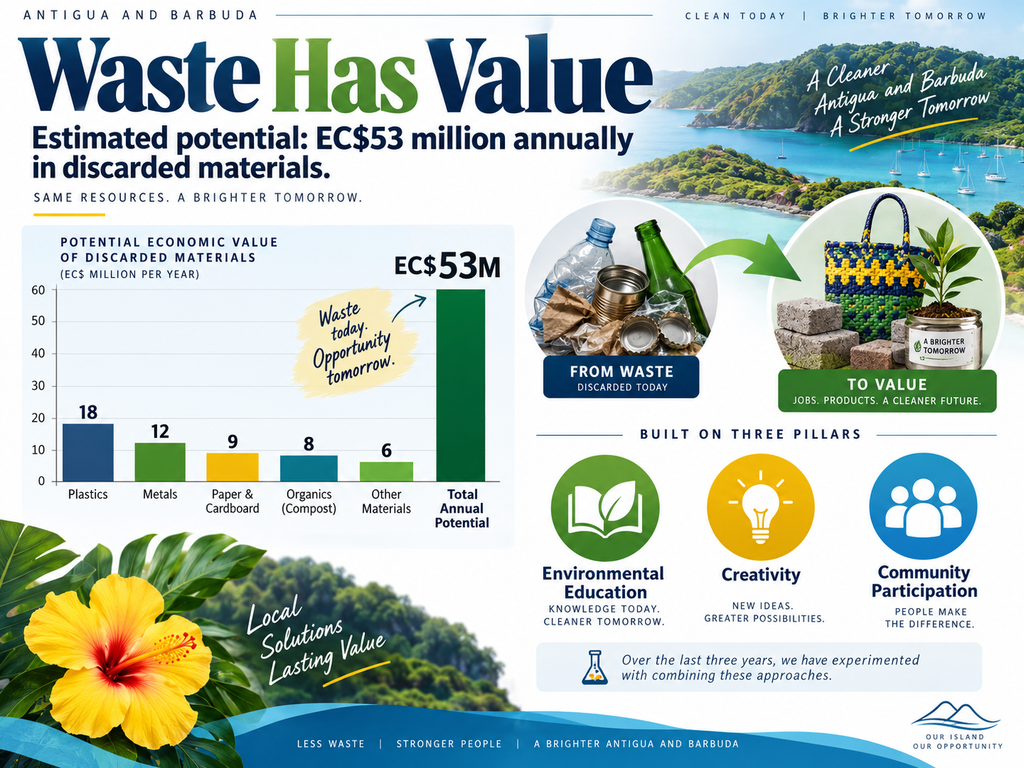
However, we also believe we need to move beyond talking about waste only as an environmental problem. What if waste is also an economic opportunity? What if materials currently being buried, burned, dumped or discarded could instead contribute to new businesses and employment? What if every household separated recyclable materials before putting out its garbage? What if every school taught children that a plastic bottle has value before that bottle ever reached a landfill? What if businesses were encouraged to think about the entire life cycle of the products they sell and the waste generated through their operations? Most importantly for our work, what if some of the employment and entrepreneurial opportunities created through a stronger waste-management sector were intentionally accessible to persons with disabilities?
That connection between disability inclusion and environmental action is an important part of what we want people to understand. When we speak about sustainability, persons with disabilities cannot be treated as spectators. They can be recyclers, educators, artists, entrepreneurs, environmental advocates, employees and leaders. A green economy that excludes persons with disabilities is not truly inclusive, and an inclusive society must create opportunities for people with different abilities to participate meaningfully in the work of building more sustainable communities. Through this project, we want to continue demonstrating two messages that have become central to our work: waste is wealth, and persons with disabilities can and should be part of the mission.
During the planned week of activities, our target is to create approximately 11 flags per day. By the end of that week, we want to have completed all 55 remaining Commonwealth flags. But the final flags are only one measure of success. The bigger achievement would be the number of conversations created along the way. Imagine a child looking at one of those flags and learning that it was made from bottle caps. Imagine that child going home and questioning why the family’s plastic bottles are being thrown into the garbage. Imagine a business owner seeing the project and beginning to question how much recyclable material their company sends to the landfill every month. Imagine a person with a disability participating in the project and seeing another space where their contribution is valued. That is how one project can create conversations that continue long after the flags are completed.
Commonwealth Heads of Government Meeting is a significant moment for Antigua and Barbuda, and we want to be part of that moment in a way that tells a uniquely environmental and inclusive story. We have an opportunity to take something people ordinarily throw away and use it to represent countries from across the Commonwealth.
We also have an opportunity to demonstrate that sustainability does not always have to begin with expensive technology or complicated programmes. Sometimes it begins with people, education, creativity and the willingness to see value where others see waste.
This is therefore our call to action to Antigua and Barbuda. We need hands. We need volunteers willing to come to John Hughes, remove bottle caps, sort them by colour and help us prepare for the week of flag-making activities. We need schools to encourage students to participate, businesses to send teams, community organisations to mobilise their members and families to make volunteering part of something they do together. Whether someone contributes one hour, several hours or an entire day, that contribution becomes part of a much larger story. Approximately 98,000 bottle caps cannot be prepared by one person, and 55 flags cannot represent community action if the community is not involved.
Perhaps one of the greatest challenges surrounding waste is not simply how much we produce, but how quickly we decide that something no longer has value. A plastic bottle can be recycled. A bottle cap can become part of a piece of art. Recyclable materials can contribute to economic activity. Environmental projects can create opportunities for persons with disabilities. A pile of discarded bottle caps can become 55 Commonwealth flags. The possibilities change when our thinking changes.
So the next time you are about to throw something away, ask yourself a few questions: Is this really waste? Could someone reuse it? Could it be recycled? Could it generate income? Could it teach someone something? Could it become part of something bigger than its original purpose?
Perhaps what we call waste is not always waste at all. Perhaps, sometimes, we simply have not yet imagined what it could become.