
By St. Paul’s News Team
August 23 2026 | International
Canadian Prime Minister Mark Carney warned months ago that middle powers could no longer assume that economic strength and traditional alliances would protect them from pressure by the world’s great powers.
Now, Canada is living through the test he predicted.
Tensions between Ottawa and Washington have escalated sharply after Carney walked away from trade negotiations with the United States, saying Washington had demanded concessions that Canada could not accept.
The confrontation intensified Saturday when the United States imposed 50% tariffs on about US$20 billion worth of Canadian goods. Carney responded by announcing dollar-for-dollar retaliatory measures beginning September 8.
“We’re going to hit back,” Carney declared.
The decision puts Canada in a difficult position. The United States is by far its most important trading partner, meaning Ottawa risks significant economic damage by confronting President Donald Trump.
But Carney appears determined to demonstrate that Canada will not sacrifice its sovereignty simply to secure tariff relief.
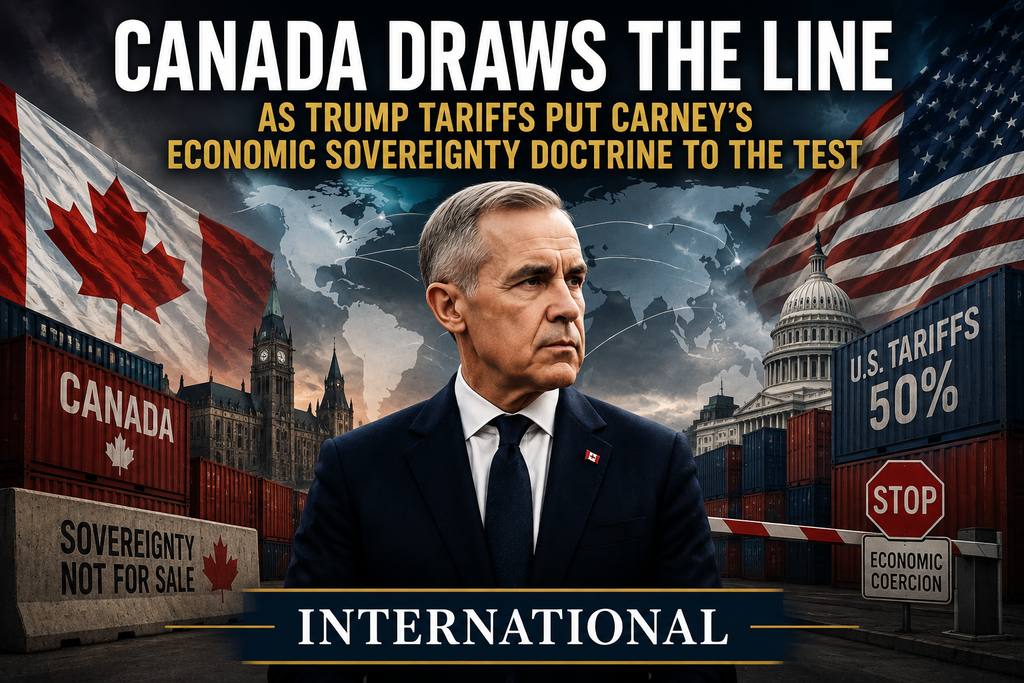
At the centre of the dispute is a demand Carney says Washington introduced during the final hours of negotiations.
According to the Canadian prime minister, the United States sought language that would restrict Canada’s ability to negotiate trade agreements with other countries.
Carney rejected the demand as “unacceptable,” arguing that it was ultimately a question of Canadian sovereignty.
British Columbia Premier David Eby went even further, warning that accepting the condition would reduce Canada “to the economic equivalent of the 51st state.”
That language carries particular weight given Trump’s repeated comments about Canada becoming the 51st U.S. state.
Trump returned to the issue Sunday, accusing Canada of wanting the benefits of statehood without actually becoming a U.S. state.
“Canada wants the benefits of being a State without being one!!!” Trump wrote on Truth Social, while also accusing Canada of imposing heavy tariffs on U.S. farmers.
The confrontation gives new significance to remarks Carney made in January at the World Economic Forum in Davos, Switzerland.
With Europe facing uncertainty over Trump’s tariff threats and his demands concerning Greenland, Carney warned that the global economic and political order was undergoing what he called “a rupture, not a transition.”
He argued that middle powers would increasingly have to develop the ability to withstand pressure from larger nations.
His message was clear: countries negotiating individually with major powers risk doing so from a position of weakness.
Trump responded bluntly at the time, stressing Canada’s dependence on the United States.
“Canada lives because of the United States,” Trump said, directing the warning at Carney.
Seven months later, those competing visions are colliding in one of the world’s most consequential economic relationships.

A test for Canada and other U.S. allies
Carney’s decision could have consequences well beyond Canada.
The outcome will be closely watched by U.S. allies that are also vulnerable to American economic pressure. If Ottawa succeeds in resisting Trump’s demands without suffering crippling economic consequences, it could strengthen the argument that middle powers can push back against coercive trade policies.
If the economic costs prove too severe, however, critics could argue that Canada’s dependence on the United States leaves Ottawa with limited room to manoeuvre.
For Carney, the stakes are therefore both economic and political.
For now, Canada has chosen confrontation over capitulation, turning Carney’s theory about economic coercion into a real-world test watched closely by governments around the globe.