
By St.Paul’s Weekly
October 4 2026 | International
Brazilians went to the polls Sunday in a closely watched presidential election pitting incumbent President Luiz Inácio Lula da Silva against Sen. Flávio Bolsonaro, as the country’s political direction hangs in the balance amid a broader rightward shift across Latin America.
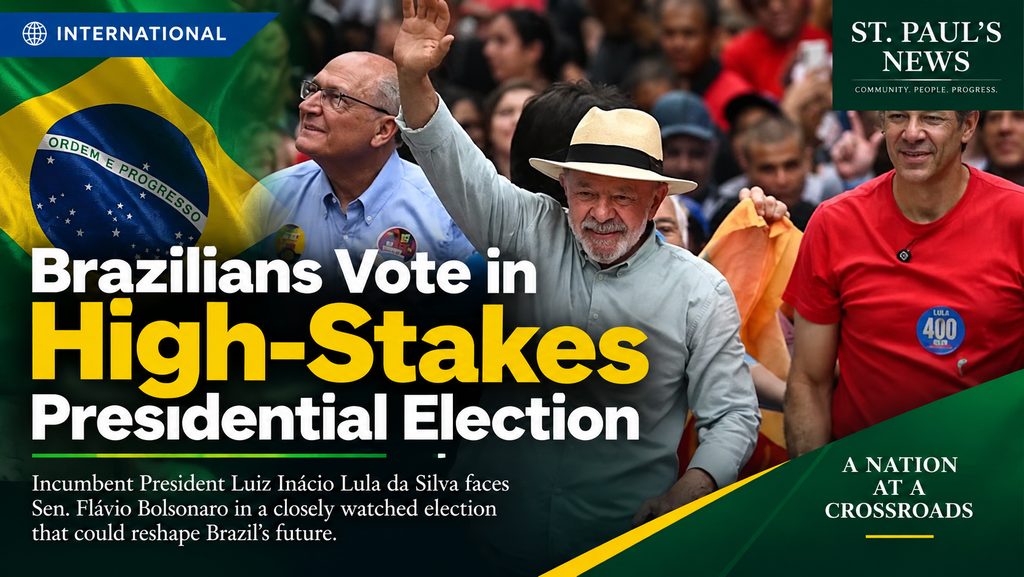
Bolsonaro, 45, is the son of far-right former President Jair Bolsonaro, who is serving a 27-year prison sentence following his conviction over an attempted coup. Flávio Bolsonaro has also emerged as a prominent ally of U.S. President Donald Trump.
Lula, 80, is seeking another term in office in what is his seventh presidential election. His administration has strengthened Brazil’s relations with China, while his government has increasingly clashed with the Trump administration over trade and other issues.
The election comes as Trump-aligned political forces have made gains in several Latin American countries, including Argentina, Colombia, Honduras and Peru.
Brazil’s presidential race features 12 candidates. If no candidate secures more than 50% of the vote, the two leading contenders will face each other in a runoff scheduled for October 25.
Nearly 159 million eligible voters are also choosing 27 state governors, members of state legislatures, all 513 members of the federal Chamber of Deputies and 54 of the Senate’s 81 seats.
For Lula, the election is a test of whether his long-standing political base can overcome concerns over the cost of living, economic pressures and a corruption scandal that has shaken confidence in his administration.

Once widely popular, Lula has seen his approval ratings decline during his third term. However, his confrontational stance toward Washington has helped strengthen support among some voters, while many others continue to credit his social programmes with improving living standards for millions of Brazilians.
Lula has repeatedly warned of possible U.S. interference in Brazil’s electoral process following a series of measures by the Trump administration, including the imposition of high tariffs on Brazilian exports, the revocation of the visa of Brazil’s ambassador and sanctions against a Supreme Court justice who oversaw investigations that ultimately led to Jair Bolsonaro’s conviction.
After casting his ballot Sunday, Lula said that, if re-elected, his administration would need to “do double of what we have done.” He also expressed confidence that he could secure victory without a runoff.
But the incumbent faces a formidable challenge, with voters increasingly focused on affordability and the fallout from a corruption investigation involving Banco Master. The controversy has also drawn attention to the Supreme Court justice who previously led the investigation into Jair Bolsonaro.
“Many in the Lula campaign were not expecting such a difficult election a few weeks ago,” said Carlos Melo, a political science professor at Insper University in São Paulo. He said the current contest has proven to be a difficult battle and suggested that future elections could become even more challenging for Lula’s political movement.
Polling stations closed at 5 p.m. Sunday, although voters who were still in line were permitted to cast their ballots. Election officials were expected to begin releasing results within hours, setting the stage for either a first-round victory or a runoff later this month.