
By Dr. A. Jerry Simon M.D
August 16 2026 | Health
I, not too long ago, saw a Facebook post of the police apprehending a man who apparently broke into someone’s business place. According to the poster, the man was found asleep, and the general consensus seems to be.
Now they may be right on both counts, but before I join in the telepathic, subconscious connection, let me posit some questions and suggestions and hopefully help to get us to a solution.
We are very good at casting blame in this country and often seem to think that some, unnamed, developed countries have the perfect solution for us. So, with the increasing crime rate, blame the police and magistrates. If a police shoot a criminal and he dies, “He could have shot him in the leg”, is the usual public response.
Sometimes I wonder if we stop and think about what would have led to situations where the police would have to encounter someone who is mentally ill in the act of committing a crime, what preventative steps we should be taking, and why the outcome is not always what we would like.
Publicly funded psychiatric service may not be the greatest in Antigua, but it is good, it is available and it is free. And many people have benefitted and still are benefitting to a high degree because of this service. Unfortunately, we often do have hear about the positive outcomes and many people do not bring their family members for psychiatric care in a timely manner.
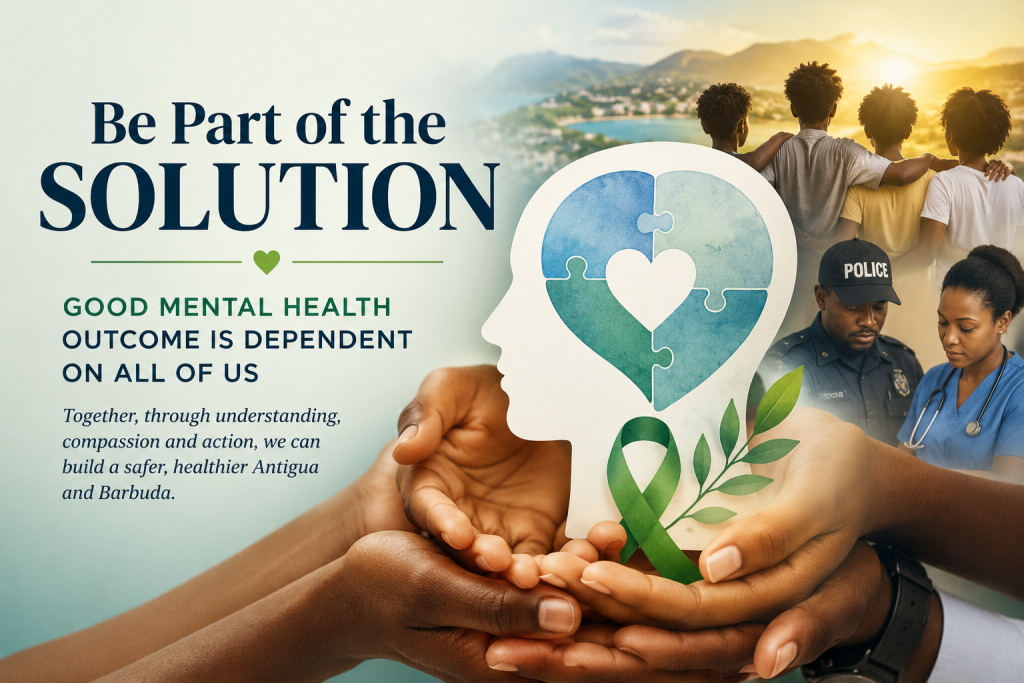
Often, the first encounter the psychiatric service gets with a patient is when he is brought to Clarevue by the police because the family members were injured, treated and are in deathly fear of their life, or when the person becomes a public nuisance, especially of a criminal nature.
But spare a thought for the police. Before arriving at the scene, how does the police know that this person has mental health issues? And even if they do what protocols can the police safely adjusted so that they and the person do not get hurt? In the case I saw this morning, the police were aiming to handcuff the man at his back and he started to resist that specific action by the police.
Some may say that police could have accommodated him but I hope they can appreciate that would have left themselves in more danger and hence it would have been likely for an even more violent confrontation to occur.
We seem to forget that officers in Antigua and Barbuda have suffered injury and death at the hands of apparently mentally ill persons in the act of trying to be kind to them. Health care workers at Clarevue have been stabbed and otherwise injured (myself included) by patients. Yes, we are trained in deescalation but when you are infront of a mentally ill patient, it is not a Hollywood movie or WWE scripted scene. If you do A, the result is not always B and you do not always have the time, space or specific setting, to completely analyse the outcome of the next step. Yes, you try your best not to unduly hurt the person but remember they are not following any rules; it is not necessarily the most rational situation. I am not making excuses for anyone’s behaviour; I am just trying to explain the reality of these acute encounters.
So let us, who get the chance to watch and past judgement, play our part in getting to the solution. When we see our family members have mental health concerns, get help early before they are at the crisis point. Monitor them closely, know their whereabouts. Work along with law enforcement and the mental health team and not take the step back and watch-on approach, just video-recording and looking to point out mistakes. If and when mistakes are found, let us seek to understand and make the systemic correction before the rash rush to judgement. By all means wrong-doing should be punished, but let us examine adequately and be fair judges.
I have dealt with many mentally ill patients, some in acute psychosis. The outcome is almost always better when the family is there working along with medical and law enforcement team, rather than those who stand off. The family often knows what triggers the patient, what may be the best approach in the acute setting. It is not because the police or healthcare worker is not trained, it is because every situation is different and there is no set of perfect steps that are automatically going to get to the desired outcome. Only by us all working together, we can have the society that we all claim to want.
