
By Dr. A. Jerry Simon
September 13 2026 | Health
In recent times there has been a lot of talk about autism and autism spectrum disorder (ASD). But what exactly is it and what should you know about it. This week I aim to give 10 key points that will help you to learn a little bit more about this topic.
Definition: Autism (commonly called autism spectrum disorder) is a lifelong neurodevelopment disorder characterized by difficulties in communication and social interactions; and by restricted, repetitive patterns of behaviour, interest and / or activities. So essentially we see a patient that has difficulty with conversation and who presents repetitive movements, insists on sameness and tends to have intense focused interests and unusual sensory response.
Duration: It is an inherited condition that starts (or rather firstly observed) in early childhood and continues into adulthood. When diagnosed early, certain measures can be put in place that help to manage the condition.
Diagnosis: Usually it is a clinical diagnosis based on observation of the characteristic behaviours. Blood tests and brain scans have limited value in making a positive diagnosis, although they may be able to rule out other brain disorders. Several mutations on different chromosomes may contribute to ASD.
Variability: Autism or ASD has a wide spectrum, ranging from patients who socially function with very little difficulty, to those who have great difficulty and need round the clock monitoring and care.
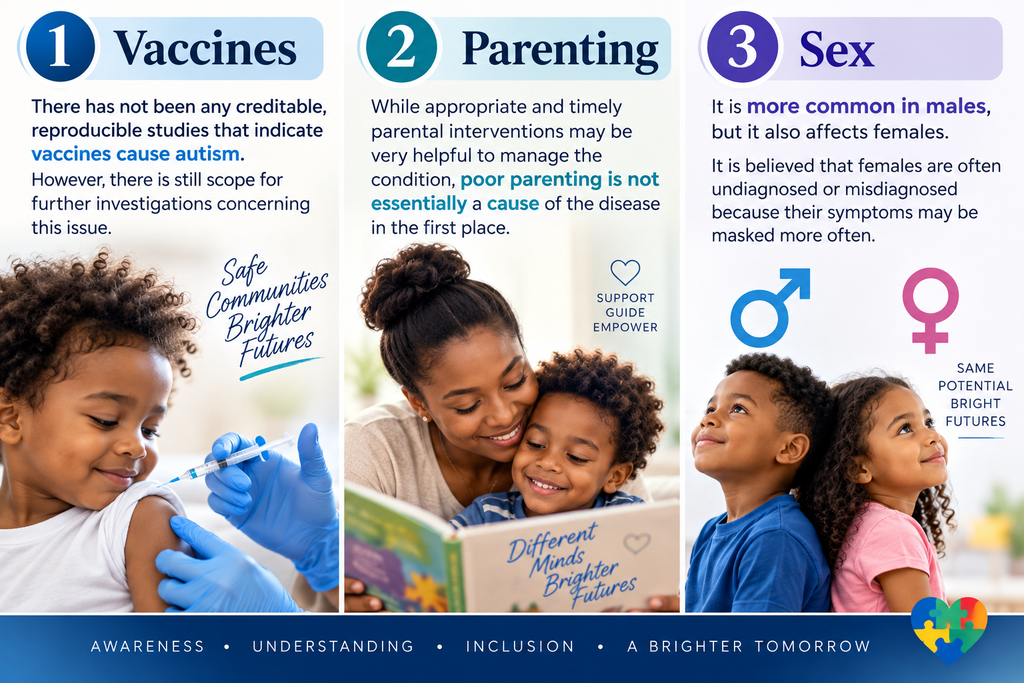
Vaccines: There has not been any creditable, reproducible studies that indicate vaccines cause autism. However, there is still scope for further investigations concerning this issue.
Parenting: While appropriate and timely parental interventions may be very helpful to manage the condition, poor parenting is not essentially a cause of the disease in the first place.
Sex: It is more common in males, but it also affects females. It is believed that females are often undiagnosed or misdiagnosed because their symptoms may be masked more often.
Repetitive Behaviours: Behaviours such as hand-flapping or rocking help with communication, self-regulation and coping with stress. If they do not cause harm or significant disruption to the patient, they may be left alone as they may indeed be very helpful to personal coping.
Strengths: Patients with ASD may find useful employment in jobs that offer clear structure, logical tasks, predictable routines and little demand for unwritten social rules or small talk. For example, they may function well in computer software development, data analysis, accounts auditing and laboratory technician.

Independence: Many autistic adults live fulfilling, independent and meaningful lives. This is especially possible with early diagnosis, adequate support and guidance, and patients with less severe disease. Some even get married and have long, happy interpersonal relationships.
While it indeed can cause significant and severe social disruption for patients and their family, autism can be managed and many patients do pass highly productive lives. More much research is still needed.
At NSA Medical Centre in Antigua we are embarking on a study of autism response to the use of CDB Cannabis compounds. For further information, please contact us at (268) 779 2176 or (268) 462 0631.