
SUNDAY, NOVEMBER 8, 2026 · ISSUE 113
A practical guide for Caribbean skin
How to Know
Your Skin Type
Read your skin before you shop for it.

You step out into the Antiguan heat and your nose starts to shine. Later, after a few hours in air conditioning, your cheeks feel tight. So which bottle do you reach for: the one for oily skin or the one for dry skin?
Look at where the change happens and when it happens. One look in the mirror after a hot afternoon tells you less than what your skin does on several ordinary days.
Get to Know Your Usual
Skin type is a useful way to describe your usual pattern of oil and dryness. Some faces shine across the cheeks as well as the nose. Others have an oily centre and dry cheeks. Some feel comfortable most of the day.
I also ask how easily skin reacts. Skin can be oily and sensitive, or dry and sensitive. Knowing both helps you choose a product your skin is more likely to tolerate.
This week’s tip: before buying a new product, watch your skin for a few ordinary days.
“Make your routine fit the skin you have and the life you live.”
01 / Your skin, decoded
Four Patterns to Look For
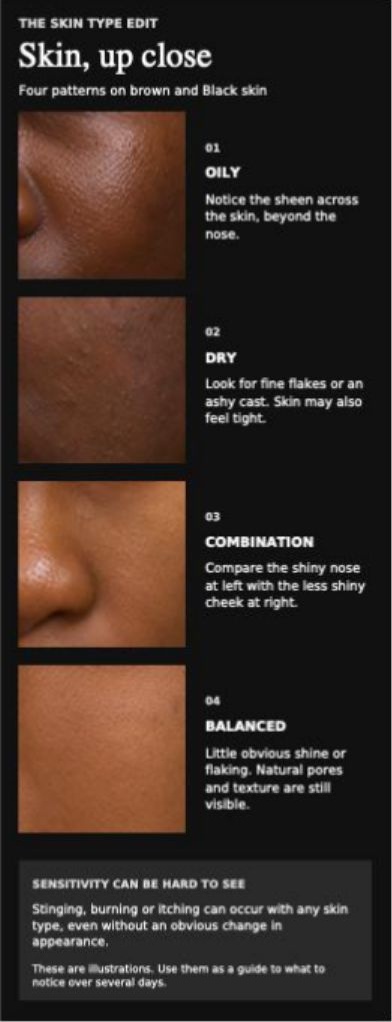
Oily
A greasy sheen returns regularly across much of the face, including the cheeks. Start with gentle cleansing. If a rich cream feels heavy, try a lighter lotion or gel labelled non-comedogenic. [1, 2]
Dry
Skin often feels tight, rough or flaky, even on ordinary days. Try a mild cleanser and a fragrance-free cream on slightly damp skin. If tightness starts only after a particular wash, take a closer look at the cleanser. [2, 3]
Combination
The forehead, nose and chin (your T-zone) get oily, while the cheeks stay comfortable or feel dry. You can use a lighter layer where you shine and a little more moisturizer where you feel tight. [2]
Balanced
Skin usually feels comfortable and you rarely see much shine or flaking. You may see this called “normal” on a label. A gentle cleanser, a moisturizer that feels good and daytime sunscreen are a sound starting point. [1]
02 / A few minutes at the mirror
Try a Three-Day Skin Check
Start with a gentle wash
On a typical morning, cleanse gently with lukewarm water and pat dry. Notice any tightness or discomfort before putting on your usual products. There is no need to wait if your skin is uncomfortable.
Compare the centre and cheeks
Later, in ordinary daylight, look separately at your forehead, nose, chin and cheeks. Note where you feel greasy, comfortable or tight. If you just exercised, cooled off from the heat or put on sunscreen, write that down too.
Look for a repeat pattern
Repeat the check for a few days with your usual routine. Keep your sunscreen on during the day. Treat your notes as a starting point for choosing products.
What Can Fool the Mirror?
Sweat can make your face shine. So can a sunscreen finish. Breakouts alone do not tell you your skin type, either. Pay attention to the pattern underneath the day’s activity and products.
A useful note: “My T-zone is oily by lunch, my cheeks stay dry, and that new serum stings.” That tells you more about what you need than one label on a bottle.
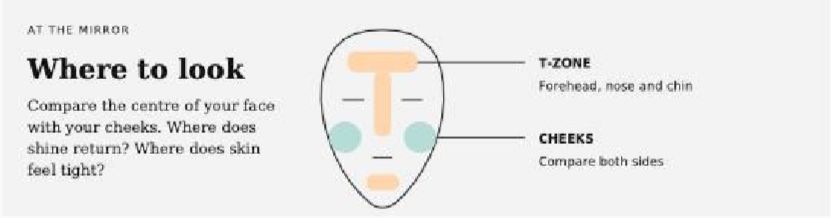
At the Mirror: Where to Look
Compare the centre of your face with your cheeks. Where does shine return? Where does skin feel tight?
T-zone: forehead, nose and chin. Cheeks: compare both sides.
03 / In conversation
Ask Leslie
Can oily skin still feel tight?
Yes. If your face gets shiny later but feels tight right after washing, review how you cleanse. A gentler wash and a light moisturizer may suit you better than scrubbing away the shine. [1, 2]
Does my skin tone tell me my skin type?
No. Brown or Black skin can be oily, dry, combination or balanced. Start with what your own skin does and how it responds.
Should I change everything at once?
Start with one change. If the new product bothers your skin, it will be easier to work out what happened. Test a new product on a small area first, following the directions. [4]
The visual guide
Skin, Up Close
Sensitivity can be hard to see. Stinging, burning or itching can occur with any skin type, even without an obvious change in appearance. These are illustrations. Use them as a guide to what to notice over several days.