
What Is Your Skin Trying to Tell You?
ST. PAUL’S MONTH | KNOW YOUR NUMBERS. OWN YOUR HEALTH.
By Leslie Nesbitt | September 27 2027
Sometimes what appears on the surface deserves a closer look underneath.
We spend a lot of time looking at our skin cosmetically. A dark patch gets called hyperpigmentation. Dryness gets another moisturizer. A bump gets treated as acne.
But your skin is an organ. Sometimes a change on its surface can be a clue to something happening elsewhere in the body.
This Health Month: CHECK IT.
That applies to blood pressure, blood sugar and cholesterol. It should also apply to your skin. If something is new, changing, persistent or unusual for you, have it evaluated.
When a Dark Patch Is More Than Pigmentation

Acanthosis nigricans can appear as darker, thicker, velvety skin around the neck, armpits or groin. It has several possible causes and can be associated with insulin resistance or prediabetes.
Do not immediately bleach it. Check it.
A new velvety patch deserves a conversation with a healthcare professional. Treating an underlying cause matters more than lightening the surface.
Clinical Insight
As an esthetician, I can observe changes in texture, pigment and inflammation. When something is unusual or may point to a medical concern, the responsible recommendation is a doctor or dermatologist — not another serum.
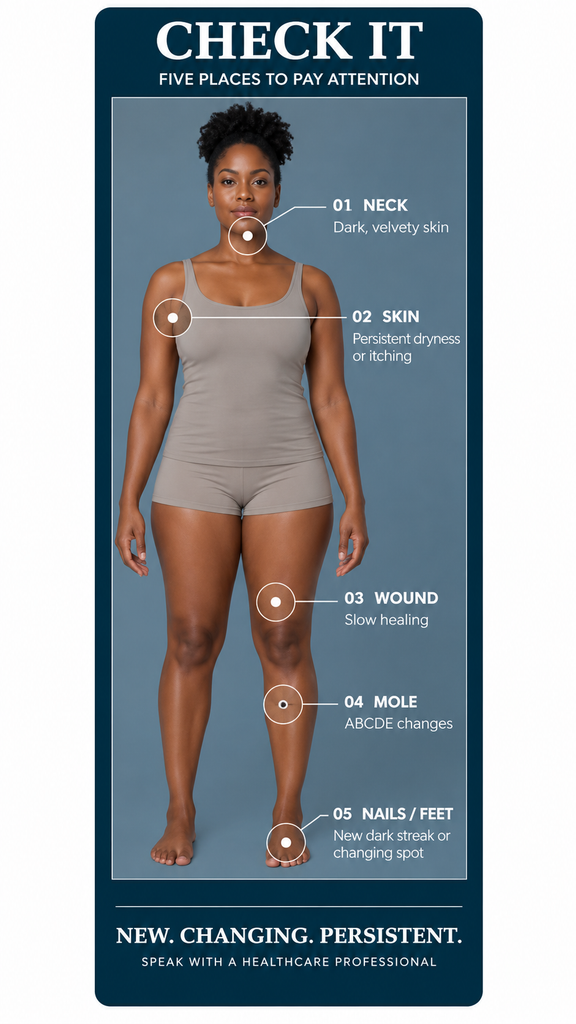
Your Skin Can Reflect Your Health
Persistent dryness or itching
Dry skin may be ordinary. Persistent, widespread or unexplained dryness and itching can sometimes accompany conditions such as diabetes or thyroid disease.
What can you do? Moisturize and protect the barrier, then seek evaluation if it continues or worsens.
Wounds that heal slowly
A cut that repeatedly fails to heal, especially on a foot, needs attention. Diabetes can impair healing and raise infection risk.
What can you do? Care for the wound and seek prompt medical advice, particularly if you have diabetes.
Sudden or severe adult acne
Adult acne is common. New, unusually severe acne, especially alongside other changes, can sometimes be linked to hormones.
What can you do? Treat the acne, and discuss unexplained accompanying symptoms with a clinician.
Check Your Spots Too
Dark skin can develop skin cancer too. Melanin does not make anyone immune. Melanoma may appear on palms, soles, or beneath and around nails.
A spot that grows, bleeds, crusts repeatedly, fails to heal, looks unlike your other spots, or creates a new dark nail streak should be examined. Do not wait for pain.
CHECK IT.
Know Your ABCDEs
A – Asymmetry
One half differs from the other.
B – Border
Edges are irregular or poorly defined.
C – Color
Different colors appear in one spot.
D – Diameter
Often over 6 mm at diagnosis, but it can be smaller.
E – Evolving
The spot changes in size, shape or color.
Beauty Tip of the Week
Know what is normal for your skin. Check your scalp, nails, palms, between your toes and the bottoms of your feet. Familiarity helps you recognize change.
What You Can Improve
Protect it. Use sunscreen and reduce unnecessary UV exposure.
Feed it. Eat a varied, balanced diet.
Hydrate it. Drink fluids and maintain the skin barrier.
Move. Support overall health with physical activity.
Sleep. Allow your body time to recover.
Do not smoke. Protect your long-term health.
Know your numbers. Follow your blood pressure, glucose and cholesterol with your healthcare team.
Above all, pay attention to change.
Skin Check: What to Notice
1. LOOK
Skin, scalp, palms, soles and nails.
2. COMPARE
Know what is usual for you.
3. NOTICE
New, changing, persistent or unusual.
4. ACT
Speak with a doctor or dermatologist.

Ask Leslie
Does every unusual skin change mean something is wrong internally?
No. Most everyday skin changes have ordinary dermatologic explanations. The point is to notice what is new, changing, persistent, unexplained or unusual for you, and have it properly evaluated rather than self-diagnosing.
Bottom Line
Your skin is what we see on the outside. Sometimes it offers clues to what is happening underneath.
During Health Month, check your blood pressure, blood sugar and cholesterol. Check your skin too.
Know your numbers. Own your health.
CHECK IT.
About This Column
SKINTIPZ by Leslie Nesbitt connects everyday skincare with skin science and practical health awareness. Cosmetic observations do not replace a medical diagnosis.
Sources
American Academy of Dermatology: Acanthosis nigricans overview; Diabetes warning signs on skin; Melanoma signs and symptoms; ABCDEs; Skin self-exam.
aad.org/public/diseases/a-z/acanthosis-nigricans-overview
aad.org/public/diseases/a-z/diabetes-warning-signs
aad.org/public/diseases/skin-cancer/abcdes-melanoma
LESLIE NESBITT
SKINTIPZ columnist
Founder of USI and Straberi Skincare
CHECK IT — Five Places to Pay Attention
01 NECK — Dark, velvety skin
02 SKIN — Persistent dryness or itching
03 WOUND — Slow healing
04 MOLE — ABCDE changes
05 NAILS / FEET — New dark streak or changing spot
NEW. CHANGING. PERSISTENT.
Speak with a healthcare professional.
