Conscious Living, Community Thriving. Cultivating a Conscious Community
By Good Humans 268 Inc
September 27 2026 | Good Humans
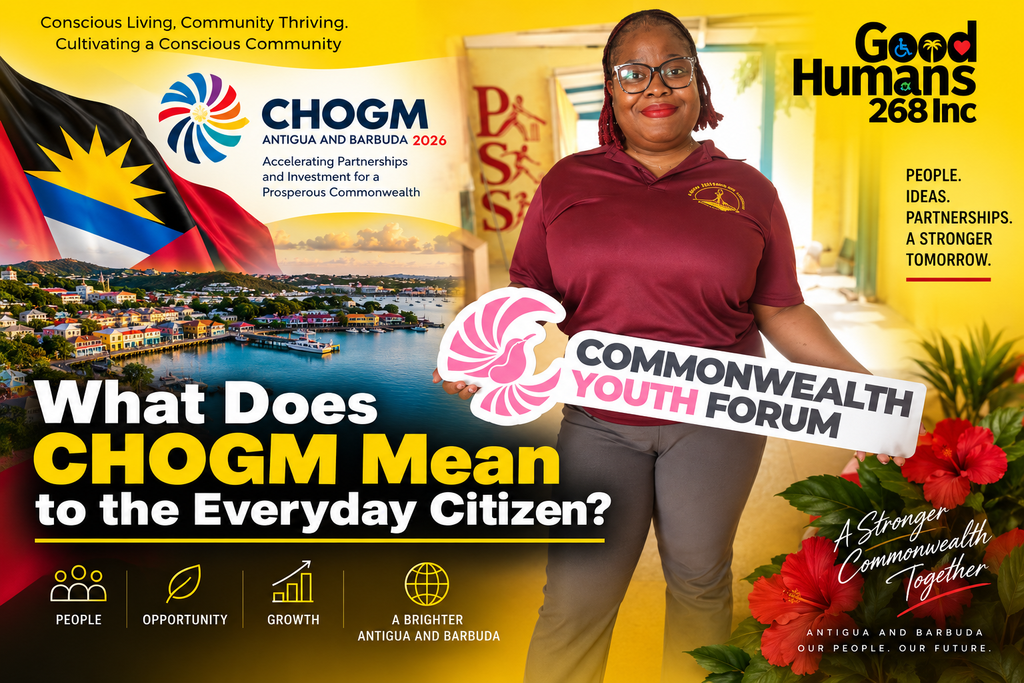
From November 1–4, 2026, Antigua and Barbuda will host the Commonwealth Heads of Government Meeting, better known as CHOGM. Leaders and representatives from 56 Commonwealth countries will gather in St. John’s under the theme, “Accelerating Partnerships and Investment for a Prosperous Commonwealth.” Discussions are expected to include climate resilience, trade, innovation, equality and sustainable
development.
But for the everyday citizen, there is a much simpler question: What does CHOGM have to do with me?
If you are not a politician, diplomat or business executive, it may be tempting to see CHOGM as a meeting happening somewhere behind closed doors. Roads will be cleaned. Buildings will be prepared. Delegations will arrive. Security will increase. Flags will go up. Motorcades will move.
Then everyone will leave. But the real value of hosting CHOGM should not be measured by what happens during four days in November. It should be measured by what remains for ordinary people afterwards.
For the taxi driver, CHOGM can mean additional passengers. For a restaurant, caterer or food vendor, it can mean additional customers. For hotels and accommodation providers, it can mean increased demand. For musicians, artists, designers, photographers, decorators and cultural practitioners, it can mean exposure and opportunities. For young people, it can mean access to new conversations, networks and possibilities. For businesses, it can mean meeting people who might otherwise never have entered our market. And for Antigua and Barbuda as a country, it is an opportunity to place a small island nation directly in front of governments, international institutions, investors and development partners.
Government preparations have already included transportation, accommodation, communications, emergency response, security, infrastructure improvements, roadworks, venue enhancements and technology upgrades. More than 800 people had also expressed interest in volunteering by June.
Some of those benefits are immediate. But the bigger opportunity is what happens next. Can relationships formed during CHOGM result in investment six months later? Can discussions about climate finance help Antigua and Barbuda strengthen vulnerable communities? Can new connections create scholarships, training programmes or employment opportunities for young people? Can improvements made for CHOGM continue serving citizens? Can our creative industries gain stronger policies and international markets? Can small businesses move from simply providing a service during the conference to establishing lasting partnerships?
Those are the questions that turn an international meeting into national development. There are also things we should be careful not to assume. Hosting a major international event does not automatically create permanent jobs, fix infrastructure or guarantee investment. A beautifully executed four-day conference is not itself a legacy. Long-term benefit depends on what agreements are made, what partnerships continue and whether opportunities reach ordinary communities.
That is why citizens should pay attention. CHOGM is also bigger than the meeting of Heads of Government. Four major stakeholder forums traditionally accompany CHOGM: the People’s Forum, Youth Forum, Women’s Forum and Business Forum. These provide spaces for civil society, young people, women, entrepreneurs and other stakeholders to participate in discussions that can feed into the wider Commonwealth process.
The People’s Forum, being held in St. John’s from November 2–4, is particularly important. It is designed to allow Commonwealth citizens and civil-society organisations to interact, exchange ideas and help shape policy and practice. For 2026, discussions include climate and environmental justice, economic inclusion and freedom of expression. The Youth Forum will bring together 300 youth delegates and will produce recommendations to be presented to Commonwealth leaders. The Women’s Forum will examine areas including leadership, economic empowerment, climate change, violence against women and accountability, with outcomes intended to inform discussions among Commonwealth leaders.
So how does the everyday citizen get involved? Start by becoming informed. Follow the forums. Attend public events where possible. Participate through community organisations, schools, youth groups, advocacy organisations and professional associations. Ask what issues are being discussed. Find out who represents your sector. Submit ideas where consultations are available. Support local businesses participating in CHOGM. Volunteer. Engage respectfully online. Most importantly, continue asking what happens after November 4.
Your voice does not become valuable because an international leader arrives on our shores. Your voice was valuable before CHOGM. CHOGM simply gives Antigua and Barbuda a larger microphone. As citizens, our responsibility is to decide what we want amplified through it. When the signs come down, the delegates leave and international attention moves elsewhere, Antigua and Barbuda will still be home.
The real success of CHOGM will therefore not be determined solely by how well we welcome the Commonwealth. It will be determined by whether the opportunities created by hosting the Commonwealth eventually reach the communities that welcomed it.