
By Kamalie Mannix
September 13 2026 | Community Spotlight
There is an ongoing conversation about the cost of living that we need to have more openly, particularly among young people.
Recently, I had the opportunity to sit down with four of my friends. It was not a formal focus group or a government consultation. It was simply four young people having an honest conversation about life.
All four of us are formally educated. Between us, we have Associate and Bachelor’s degrees. All four of us are employed.
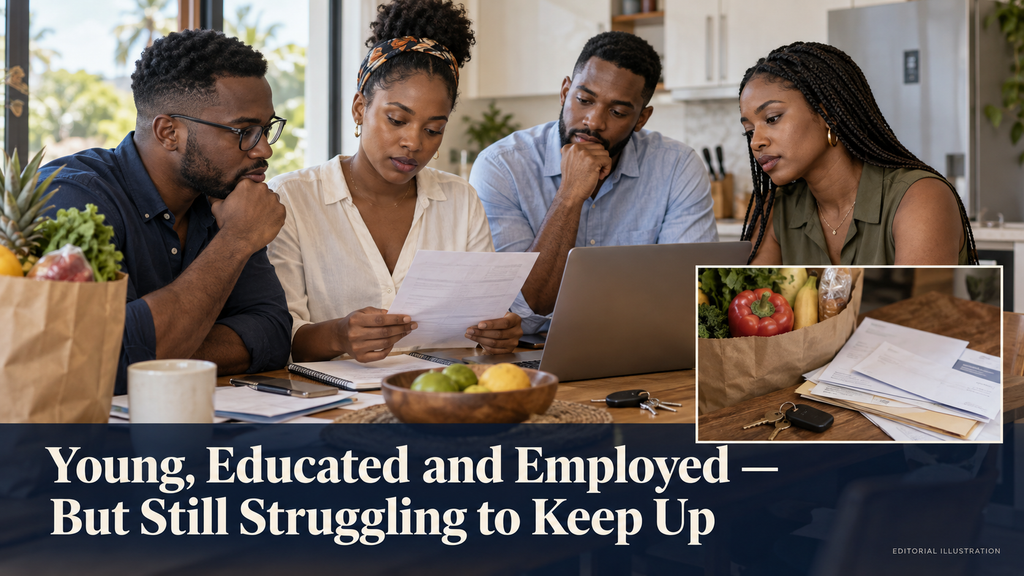
Yet, when we discussed what is causing the greatest financial stress in our lives, four issues immediately stood out: food, housing, utilities and children.
That conversation reminded me of something important: having an education and having a job does not necessarily mean that a young person is financially comfortable.
For many young people, the biggest challenge is no longer deciding what luxury they can afford. It is figuring out how to comfortably afford the basics.
The grocery bill keeps climbing. Rent and mortgages can consume a significant portion of a salary. Electricity, water, internet and other utilities continue to take their share. And for those who have children, the financial responsibility becomes even greater.
Then there are transportation costs, insurance, school expenses, emergencies, debt, savings and the expectation that young adults should somehow be building a future at the same time.
We are living in a period where international events can have very local consequences. Wars and geopolitical instability, including the ongoing conflict involving Russia and Ukraine and renewed conflict involving Iran and the wider Middle East, can affect energy markets, shipping, food prices and ultimately what Antiguans pay at the supermarket and petrol station.
For a small island economy that imports much of what it consumes, these pressures are not abstract.
When the price of fuel increases, almost everything becomes more expensive.
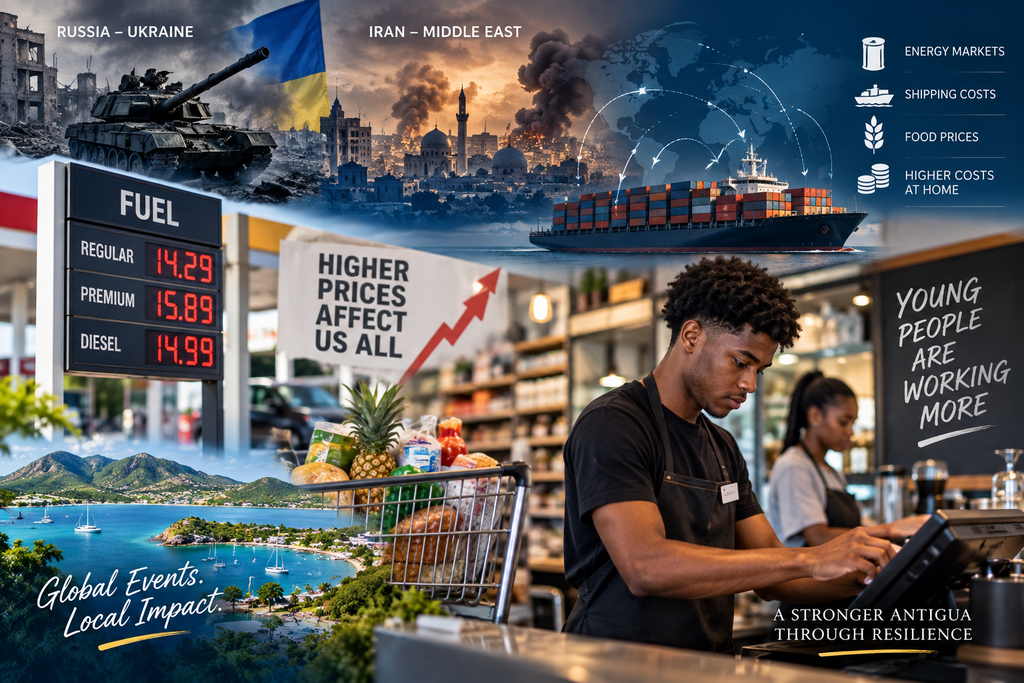
One of the ways young people are coping is by working more.
A young person may have a full-time job during the day, work a second job in the evening and take on freelance or entrepreneurial work on weekends.We call it ambition. We call it the “side hustle.”
And sometimes it is.
But we should also ask ourselves: How much of this is ambition, and how much is survival?
There is a difference between a young person taking on additional work because they want to
build a business and a young person taking on additional work because their primary salary cannot cover their basic expenses.
The danger is that constant financial pressure eventually has consequences beyond the bank account. It affects relationships, mental wellbeing, health, family life and the amount of time young people have to participate in their communities.
We cannot expect young people to volunteer, lead organisations, build businesses, participate in civic life and contribute to national development if they are spending every waking hour trying to make ends meet.
Are We Delaying Our Dreams?
The cost of living is also influencing some of the biggest decisions young people make.
Some are delaying marriage. Some are delaying having children.
Some are choosing not to have children at all because they do not believe they can afford to provide the quality of life they want for them.
Others are postponing buying a home, pursuing further education or starting a business because there simply isn’t enough disposable income left after the necessities are paid. These are not merely personal decisions. Collectively, they can have implications for the future of our country.

A generation that feels it cannot afford to build a family, purchase a home or invest in its future is a generation that may become increasingly disconnected from the traditional idea of economic security.
When Pressure Becomes Desperation
We also have to be honest about the darker side of the conversation.When people feel trapped financially, some eventually make decisions they would not otherwise make.
Some fall into debt. Some become dependent on others. Some turn to illegal activity. Others engage in unethical or questionable ways of making money simply to supplement their income.
That does not excuse criminal or immoral behaviour. But if we want to address these problems seriously, we must understand the environment in which some of these decisions are being made. ujkiiEconomic pressure does not justify wrongdoing, but ignoring economic pressure does not make it disappear.
So What Do We Do?
The answer cannot simply be, “Young people need to work harder.” Many already are. We need to have a broader national conversation about wages, housing, food security, energy costs, transportation, childcare and opportunities for young people to build wealth.
We need to look seriously at affordable housing options for young professionals and young families. We need to encourage entrepreneurship while making it easier for young people to access capital and grow legitimate businesses.
We need to examine how we can reduce our vulnerability to international shocks by strengthening local production, agriculture and renewable energy.

And we need employers to recognise that retaining young talent requires more than simply providing a salary. Opportunities for advancement, professional development and decent working conditions matter.
Most importantly, we need to listen to young people themselves.
The four of us sitting around a table may not represent every young person in Antigua and Barbuda. But our conversation reflects a reality that many young people are experiencing: we are educated, we are working, we are trying to build, but increasingly, we are struggling to keep up.
The question is not whether young people are willing to work. The question is whether the economy is allowing their hard work to translate into the lives they were promised it would create.
Our young people should not have to choose between surviving today and building tomorrow.
The future of Antigua and Barbuda depends on making sure they can do both.