
By St. Pauls News Team
August 16 2026 | Featured Story
Antigua and Barbuda is positioning itself at the centre of the global conversation on artificial intelligence, co-hosting a major AI Summit at the United Nations in Geneva aimed at ensuring small states have a voice in shaping the technology that will define the future.
The two-day summit, held from August 12 to 14 in collaboration with the AI for Developing Countries Forum (AIFOD), brought together governments, international organisations, policymakers, technology experts and industry leaders under the theme, “Small Takes the Lead: The Future Belongs to the Many, Not the Few.”
The discussions focused on a critical question for developing and small island states: Will they remain consumers of powerful emerging technologies, or can they become architects of the systems that increasingly influence economies, security, governance and international affairs?
Antigua and Barbuda’s Foreign Affairs, Trade and Immigration Minister, Hon. E.P. Chet Greene, who also has ministerial responsibility for Artificial Intelligence, delivered the keynote address at the opening of the summit.
Speaking under the theme “Small Takes the Lead: From Clients to Architects of Intelligence,” Greene called for a fundamental shift in how small states participate in the global AI revolution.
He argued that small countries must move beyond simply adopting technologies developed elsewhere and become active participants in determining how AI is developed, governed and deployed.
Greene reaffirmed Antigua and Barbuda’s support for empowering small states to become “architects of intelligence that will define our collective future,” while calling for greater digital equality and meaningful representation in global AI decision-making.
“Wherever the future of AI is being written, the Global South must be present,” Greene declared. “Wherever the future of AI is being written, the Global South must be present,” he added.
For Small Island Developing States, Greene said, control over critical AI systems is not simply a question of technological advancement. It is a matter of national resilience and survival.
He pointed to the potential of AI to transform early-warning systems, disaster response, coastal monitoring and the blue economy, areas of particular importance to countries vulnerable to climate change and natural disasters.
But Greene stressed that these systems must be locally owned and governed, aligned with national laws and capable of functioning even when connectivity is disrupted.
“These critical systems must be ours,” he said, while also calling for the development of local expertise to support them.
The Minister argued that international assistance should not be viewed as charity, but as an investment in global resilience. “A resilient SIDS is a resilient world,” he said.
Greene also highlighted the potential power of collective action, pointing to growing support among countries of the Global South for a permanent platform to negotiate collectively on AI and emerging technologies.
“Collective action is not merely strategy, it is solidarity,” he said.
Opening the second day of the summit, Joy-Marie King, Director of International Trade, focused on the strategic importance of ensuring that small nations are properly positioned within the rapidly expanding global AI ecosystem.
King said small states must use collective action to strengthen their technical and negotiating capacity while building strategic partnerships with universities, industry leaders and international organisations.
She also stressed the importance of regional cooperation and joint diplomatic platforms.
Such cooperation, she argued, can help small states move from simply reacting to technological developments to influencing the standards, frameworks and partnerships that will ultimately govern the future of AI.
The summit therefore provided Antigua and Barbuda with an important platform to advance the interests of Small Island Developing States in discussions surrounding artificial intelligence, digital transformation, innovation and emerging technologies.
The country’s leadership at the Geneva summit reflects its growing push to ensure that the concerns of SIDS are included in global discussions on technologies that could have profound implications for development and governance.
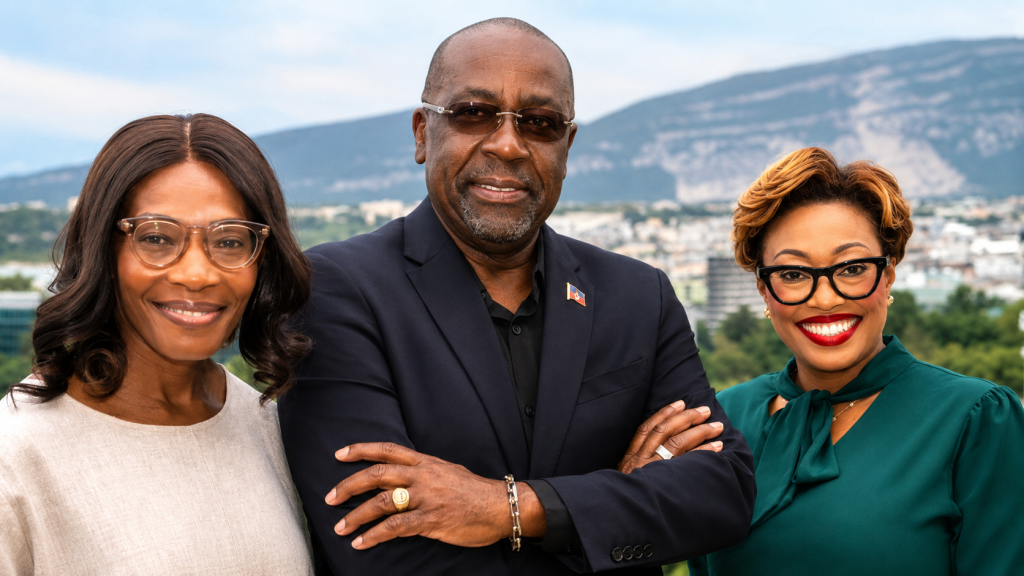
Antigua and Barbuda’s delegation comprised Hon. E. P. Chet Greene, Minister of Foreign Affairs, Trade and Immigration, Miss Joy-Marie King, Director of International Trade and Miss Andrea Jacobs, Crown Counsel and National AI Focal Point.
Through its participation and leadership at the United Nations, Antigua and Barbuda is making the case that size should not determine influence in the digital age.
For the country and other small states, the message coming out of Geneva is clear: the AI future should not be written exclusively by the world’s largest powers and technology companies. Small states want a seat at the table, a voice in the negotiations and a role in building the systems that will shape their future.